# STRAT Economics

## The Revenue Model

Most DeFi tokens derive value from governance rights, inflationary rewards, or speculative narratives. STRAT derives value from something simpler: **the protocol borrows at zero interest, and the implied option premium is the revenue.**

When a user purchases a USD-denominated [convertible note](https://docs.ethstrat.xyz/core-mechanics/convertible-notes) (paying with ETH), they receive CDT (fungible debt) plus an NFT option (conversion rights). The protocol acquires the ETH for its treasury without paying interest. In traditional finance, this would cost 5-10% annually. In ETH Strategy, the cost is zero because the conversion option itself is what the buyer values — the right to convert into STRAT or esETH at a predetermined rate.

The value of that conversion option is the protocol's **implied option premium**. It's not paid in cash — it's embedded in the structure. The bonder effectively "pays" by accepting conversion rights instead of interest. The protocol effectively "earns" by borrowing capital at no ongoing cost.

This is the same economic engine behind MicroStrategy's convertible note strategy. For a detailed comparison, see [MSTR Comparison](https://docs.ethstrat.xyz/tokenomics/mstr-comparison).

## Two Revenue Sources

### 1. Implied Option Premium (Primary)

Every convertible note issued adds ETH to the treasury without adding interest expense. The spread between the capital received and the zero cost of borrowing is the implied option premium. As long as there is bonding demand — users who want conversion optionality, non-liquidatable borrowing, or downside-protected ETH exposure — the protocol generates revenue.

This revenue is **structural, not extractive**. The protocol doesn't charge fees for bonding. The revenue exists because the capital structure itself is efficient — zero-interest debt funded by the value of conversion rights.

### 2. Treasury Lending Interest (Secondary)

[Treasury Lending](https://docs.ethstrat.xyz/core-mechanics/treasury-lending) allows STRAT holders to borrow esETH from the protocol treasury by burning STRAT and CDT to open a fixed-rate loan position. The interest paid by borrowers flows to the [StakedStrat](https://docs.ethstrat.xyz/core-mechanics/strat-staking) contract, where it is distributed to STRAT stakers as esETH rewards via the 7-day streaming mechanism.

This creates a second, more traditional revenue stream: borrowers pay interest, stakers earn yield. The revenue is real, denominated in esETH, and backed by actual demand for liquidity — not token inflation.

{% hint style="info" %}
Treasury Lending is on the [roadmap](https://docs.ethstrat.xyz/introduction/roadmap) for Q2 2026. Once live, it becomes the primary ongoing yield source for STRAT stakers.
{% endhint %}

## The Flywheel

ETH Strategy's value accrual isn't linear — it compounds. Each mechanism in the protocol reinforces the others:

<figure><img src="https://4118867301-files.gitbook.io/~/files/v0/b/gitbook-x-prod.appspot.com/o/spaces%2FdVsn8HPU0Wps7d1zQcgD%2Fuploads%2FwDjaDxRhhr3REksmMyn8%2FProtocol%20Overview.png?alt=media&#x26;token=9ec0fc5a-8b6f-4df5-a89e-e88daa072573" alt="ETH Strategy flywheel — how bonding, staking, lending, and conversion reinforce each other"><figcaption><p>The protocol flywheel: bonding grows the treasury, staking earns yield, lending creates revenue, and conversion burns debt.</p></figcaption></figure>

1. **Bonding grows the treasury.** Every bond adds ETH. More ETH in the treasury means higher ETH per STRAT (EPS) — making STRAT more valuable.
2. **Higher STRAT value increases bonding appeal.** As STRAT appreciates, the conversion rights embedded in new notes become more attractive. More bonding demand → more zero-interest capital flowing into the treasury.
3. **Treasury lending generates yield.** The treasury isn't idle — STRAT holders borrow against it, paying fixed-rate interest that flows to stakers as esETH. More treasury → more lending capacity → more interest revenue.
4. **Real yield drives STRAT demand.** Sustainable yield from protocol revenue (not emissions) attracts stakers. More demand for STRAT supports the premium to NAV — and the [PCF/GCF pricing formula](https://docs.ethstrat.xyz/core-mechanics/convertible-notes#conversion-entitlement-pricing) means higher premiums grant fewer STRAT per bond, protecting existing holders from dilution.
5. **Conversion burns debt.** When note holders convert, CDT is destroyed — reducing total protocol obligations. Lower debt improves the treasury-to-debt ratio, making remaining STRAT more valuable.

Each cycle makes the next one stronger. The protocol gets better as it grows — and unlike emission-based yield farming, nothing in this flywheel requires inflating the token supply. STRAT is only minted when someone actively chooses to exercise conversion rights.

## Why STRAT Trades at a Premium to NAV

STRAT's net asset value (NAV) is the esETH backing per token — total treasury esETH divided by STRAT supply. But the market price of STRAT should exceed NAV for as long as the protocol can continue issuing convertible notes at attractive terms. Here's why:

1. **Future revenue is priced in.** Each new bond adds more ETH to the treasury than the dilution it creates in STRAT supply, because the bonding mechanism prices conversion entitlements using the [PCF/GCF formula](https://docs.ethstrat.xyz/core-mechanics/convertible-notes#conversion-entitlement-pricing) that accounts for existing treasury value and premium.
2. **Revenue multiples apply.** Just as stocks trade at multiples of earnings, the market can apply growth projections to the implied option premium and lending interest, pricing in expected future issuance and revenue.
3. **Supply constraints limit dilution.** STRAT is minted only when note holders exercise conversion — not through inflation, emissions, or governance. This means dilution only happens when someone actively burns CDT against their NFT option, which requires both tokens and only occurs when the holder believes STRAT is worth more than the conversion rate.

## Demand Drivers for Convertible Notes

The implied option premium only exists if people want to bond. Three use cases drive bonding demand:

### 1. Non-Liquidatable Borrowing on ETH

Users who hold ETH and want liquidity without liquidation risk can purchase a note and then sell CDT:

1. Purchase a convertible note (send ETH) to receive CDT + NFT option
2. Sell CDT on the open market for immediate liquidity — similar to borrowing, but without margin calls or variable rates
3. Retain the NFT option, preserving the right to convert back into STRAT (and thus ETH exposure) at any time before expiry

The CDT sale provides immediate liquidity. The NFT option preserves upside. No oracle can liquidate this position. The only "risk" is that the conversion rate may be less favorable than directly holding ETH — but for users who need liquidity, this is often an acceptable trade.

### 2. Downside-Protected ETH Exposure

A user seeking ETH exposure with defined downside can purchase a convertible note and hold it:

* **If ETH rises** — convert to STRAT or esETH, capturing most of the upside from the initial bond
* **If ETH falls** — after expiry (\~4.2 years), redeem CDT for the original USD notional value, paid in esETH. If the protocol is solvent, you get your dollar value back. If it's underwater, you receive a pro-rata share

This is a structured product with optionality on both sides — but it requires patience and comfort with illiquidity during the note's term.

### 3. Gamma Scalping

The conversion rights embedded in the NFT option have quantifiable value as derivatives. Sophisticated participants can extract this value through gamma scalping — shorting the underlying to create delta-hedged positions and profiting from price movement through the option's convexity. In DeFi, perpetuals with positive funding rates can make gamma hedging even more profitable than in traditional markets.

## Supply and Exercise Constraints

* **STRAT supply** — STRAT is minted only upon conversion (burning CDT + NFT option). There is no inflation schedule, no governance minting, no team emissions. All new STRAT enters circulation because someone chose to exercise their conversion rights.
* **CDT supply** — CDT is created solely through bonding. Total CDT supply equals total protocol debt obligations — a transparent, on-chain measure of leverage.
* **Exercise requires CDT** — You cannot convert an NFT option without burning the corresponding CDT. This means even if NFT options are abundant, demand for CDT persists because it's the key that unlocks conversion. This creates sustainable buy pressure on the debt token.

## How ETH per STRAT (EPS) Grows

The core metric for STRAT holders is ETH per STRAT (EPS):

```
EPS = total esETH in treasury / total STRAT supply
```

EPS increases when:

1. **New bonds are issued** — if the bonding terms are favorable (i.e., the conversion rate gives fewer STRAT per ETH bonded than the current EPS would imply), the treasury grows faster than STRAT dilution
2. **Debt is retired cheaply** — if the protocol or market participants buy CDT below face value and burn it, debt decreases without reducing the treasury
3. **Borrowers default** — delinquent fees from [Treasury Lending](https://docs.ethstrat.xyz/core-mechanics/treasury-lending) are forfeited to unencumbered holdings, directly boosting EPS for remaining holders
4. **LST yield is harvested** — the underlying liquid staking tokens backing esETH generate staking rewards, which are periodically harvested into the treasury

EPS can decrease when conversion rights are exercised (STRAT is minted against existing treasury assets), but this only occurs when a holder actively chooses to convert — and the conversion entitlements are set at bonding time, so the impact is known and bounded.

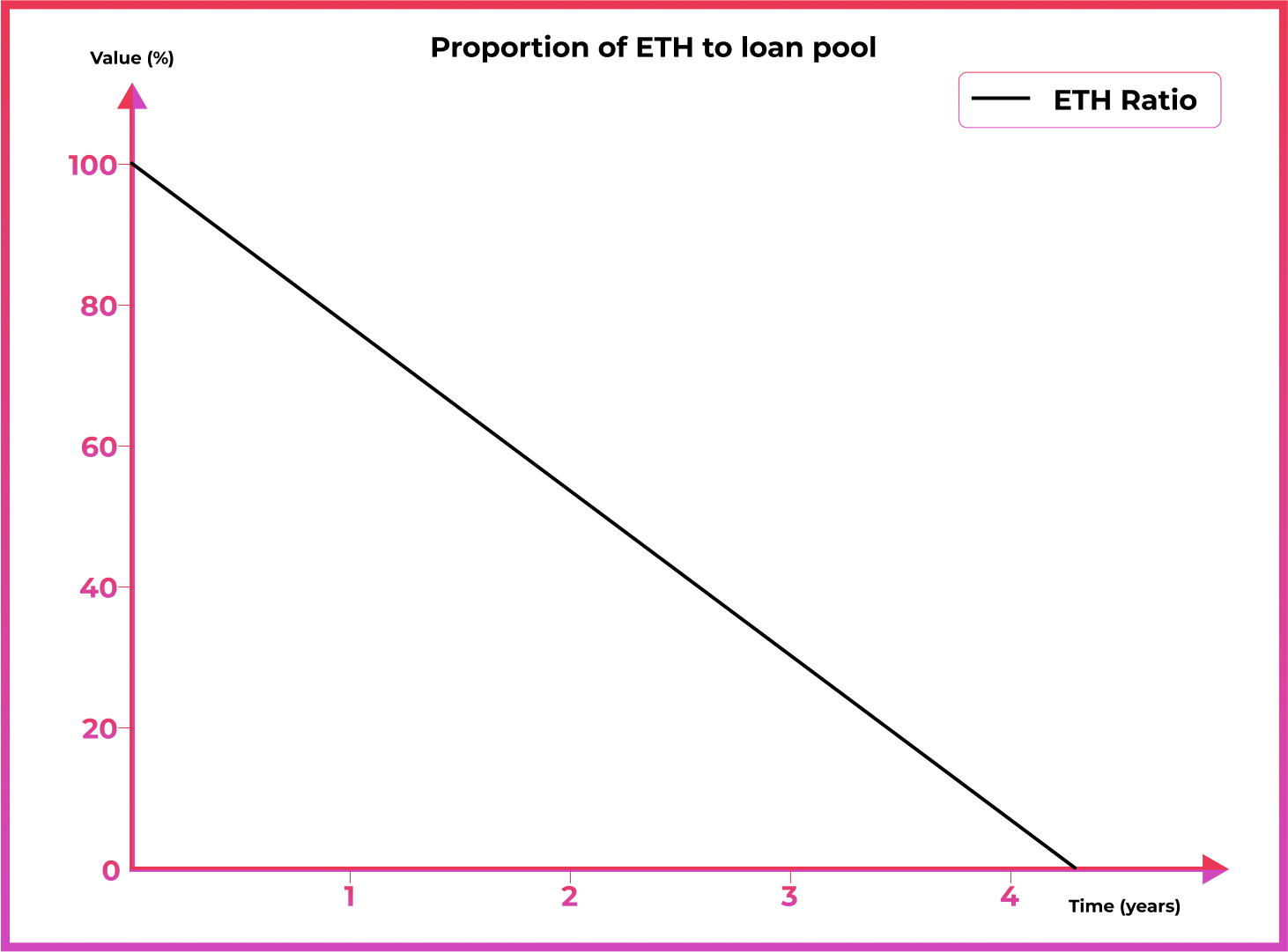
<figure><img src="https://4118867301-files.gitbook.io/~/files/v0/b/gitbook-x-prod.appspot.com/o/spaces%2FdVsn8HPU0Wps7d1zQcgD%2Fuploads%2Fgit-blob-ce0a1ba1490f3a178c4b914f7e861c7784dae315%2FETH%20Ratio.png?alt=media" alt="ETH per STRAT ratio"><figcaption><p>ETH per STRAT (EPS) is the core performance metric — it increases as the treasury grows faster than STRAT dilution.</p></figcaption></figure>